


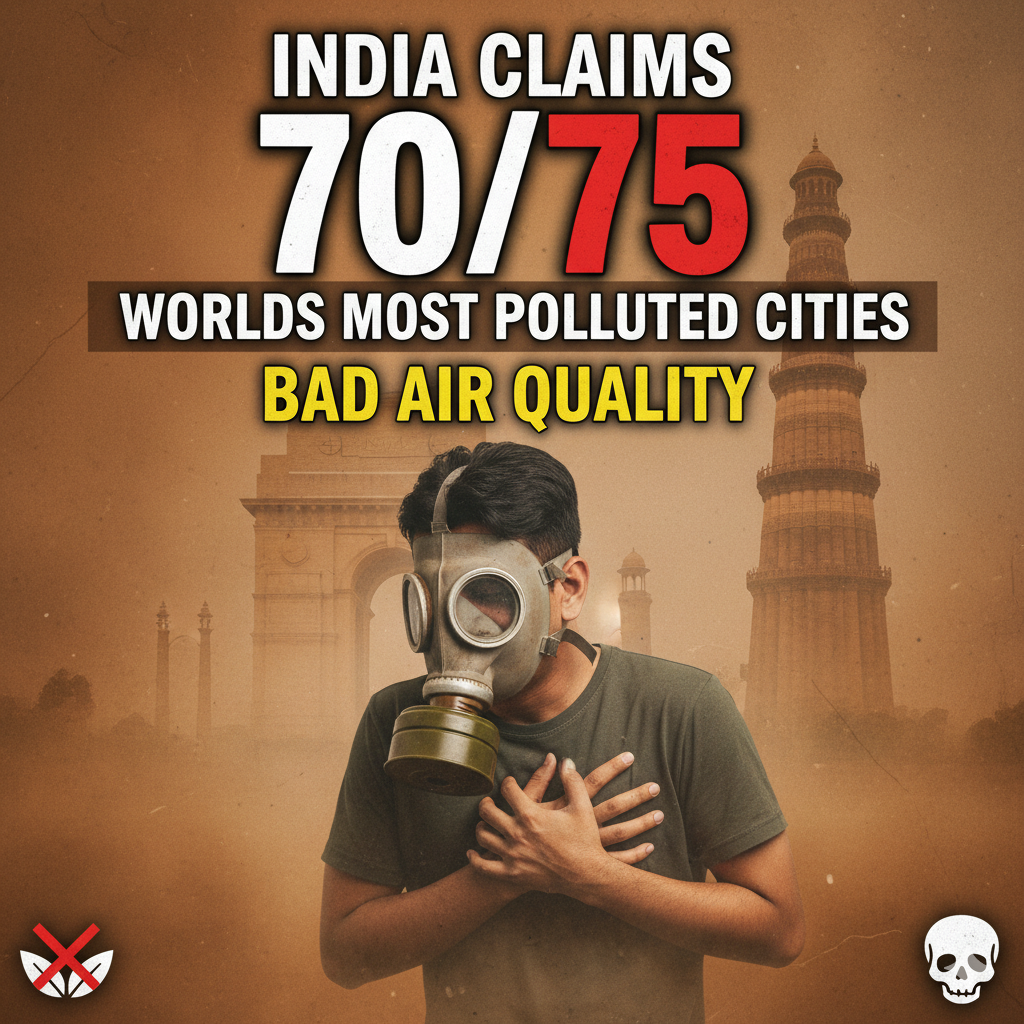
India’s air-quality crisis has grabbed global attention after multiple live AQI rankings and news posts circulated the striking claim that “70 of the top 75 most polluted cities” in the world are in India. While the exact number varies by dataset and timeframe, independent air-quality monitors and annual reports show a consistent, alarming pattern: Indian cities dominate global lists of worst air pollution, reflecting deep structural problems across transport, industry, power, and seasonal crop-burning.
What the headline refers to
The “70 of 75” figure appears most often in live AQI dashboards and social posts that snapshot hourly or daily rankings of polluted urban centres. These live rankings can spike when many Indian locations report hazardous levels simultaneously — for example during winter stubble-burning and seasonal weather inversions. Longer-term annual reports (which average measurements across the whole year) show similar dominance: several authoritative reports put dozens of India’s cities among the world’s most polluted — in some reports as many as 83–94 of the global top 100. That nuance matters: live snapshots can show short-term concentration of Indian cities, while annual averages show persistent, systemic pollution.
Why India features so frequently on pollution lists?
Multiple drivers combine to push urban India’s PM2.5 levels far above safe limits: vehicle emissions from a rapidly expanding fleet, industrial emissions in and around cities, construction dust, unmanaged municipal waste burning, and seasonal agricultural residue burning in the north. Geography and seasonal weather (winter temperature inversions and low wind) trap pollutants, causing sharp spikes that affect large populations. Poorer households’ reliance on solid fuels for cooking in some regions also contributes to particulate loads. These are not short-term glitches but structural problems that require policy and infrastructure shifts.
Health and economic consequences
Fine particulate matter (PM2.5) penetrates deep into lungs and the bloodstream. Long-term exposure increases risks of heart disease, stroke, chronic lung disease, and premature death. The human cost is matched by economic losses: increased healthcare spending, lost workdays and lower productivity, and long-term burdens on public health systems. Public health experts estimate millions of life-years are lost annually due to air pollution in India.
What governments and cities are doing (and must do)
Indian central and state governments have launched national clean-air programs, including stricter vehicle-emissions norms, incentives for cleaner fuels, expansion of monitoring networks, and campaigns to reduce crop burning. Cities are piloting low-emission zones, improving public transport, and accelerating electrification of buses and two-wheelers. Still, experts warn that stronger enforcement, investment in clean energy (especially replacing coal where feasible), waste-management reform, and long-term urban planning are essential to reverse the trend.
How to read future headlines
When you see claims like “70 of the 75 worst” it’s important to check the source, the timeframe (hourly snapshot vs. annual average), and the pollutants measured (PM2.5 is the standard metric for long-term risk). Reliable sources include annual reports from established air-quality monitors (e.g., IQAir/World Air Quality Report) and national monitoring portals. Short snapshots are useful for immediate warnings but don’t replace long-term trend analysis.
Conclusion
Whether the count is 70 of 75 in a live snapshot or 83–94 of the top 100 in annual rankings, the takeaway is the same: India faces a major air-quality emergency. Turning the tide will require coordinated action across energy, agriculture, transport, and urban planning — plus transparent data and consistent enforcement. For readers, the best immediate protection remains awareness (checking local AQI), limiting outdoor exertion during hazardous episodes, and supporting policies and leaders that prioritize clean air.